
Exploring South Korea's dog meat industry
Big news as of January 9th, 2024!
South Korea's parliament passed a bill to ban the eating and selling of dog meat, a move that will end the controversial centuries-old practice amid growing support for animal welfare. The legislation, which states its purpose is "to eradicate the consumption of dogs" will take effect after a three-year grace period (2027). The breeding and slaughtering of dogs to produce meat for human consumption will be punishable by up to three years in prison or 30 million won ($22,800) in fines. The bill does not stipulate any penalties for eating dog meat per se. Support for the ban has grown under President Yoon Suk Yeol, an animal lover who owns six dogs and eight cats with first lady Kim Keon Hee, also a vocal critic of dog meat consumption. Pet ownership has also climbed over the years. One in four Korean households owned a pet dog in 2022, up from 16% in 2010, government data shows.
About 2.5 million dogs are raised in South Korean dog farms each year and about 1 million are killed and eaten. The rest are used for breeding, as dog farms are notorious for having high mortality rates and frequently require new livestock, according to Humane Society International, a Washington, D.C.-based organization that advocates for animal protection worldwide.
Mainstream South Korean cultural mindset towards dogs began changing in the 1980s and ’90s in part due to the rise in national wealth and globalism spreading Western cultural norms. Younger Koreans began advocating for abolishment of dog farms and one-third of Korean households keep dogs as pets. Korean media and animal activism have worked tirelessly to see to the elimination of the dog meat industry and about 70 percent of South Korea's 51.5 million population disapprove of eating dogs, according to a July 2017 survey cited by Humane Society International.
This cultural shift counters a long history suggesting that Koreans have been eating dogs for more than a thousand years. This was a familiar food source during the near-starvation years of Japan’s brutal occupation of Korea, World War II, and the Korean War. Historically, dogs have been considered farm animals in South Korea, and dogs are more readily available than other livestock. Now, however, the farming of dogs for slaughter is practiced as a tradition, rather than a necessity. South Koreans who eat dog meat eat much of it during Boknal, the hottest days of the year, in July and August. During this time, it is believed that consuming dog revives energy or male potency sapped by the heat. Dog meat is frequently found in bosintang stew or the drink gaesoju as "a soup form of Gatorade," according to American food writer Joe McPherson in a 2015 UPI interview.
While the number of dog farms has been reduced, nearly 17,000 still remain in South Korea.
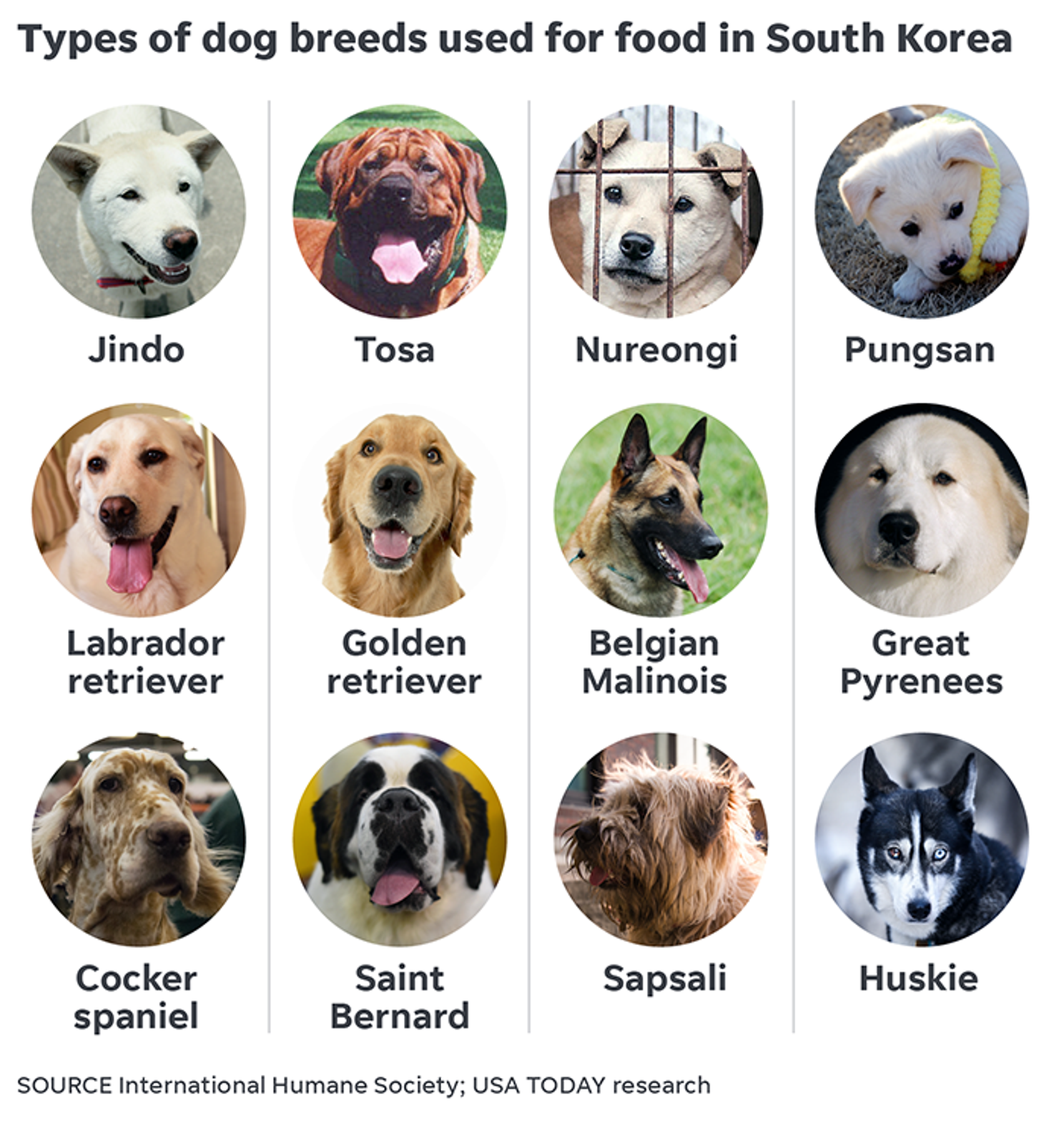
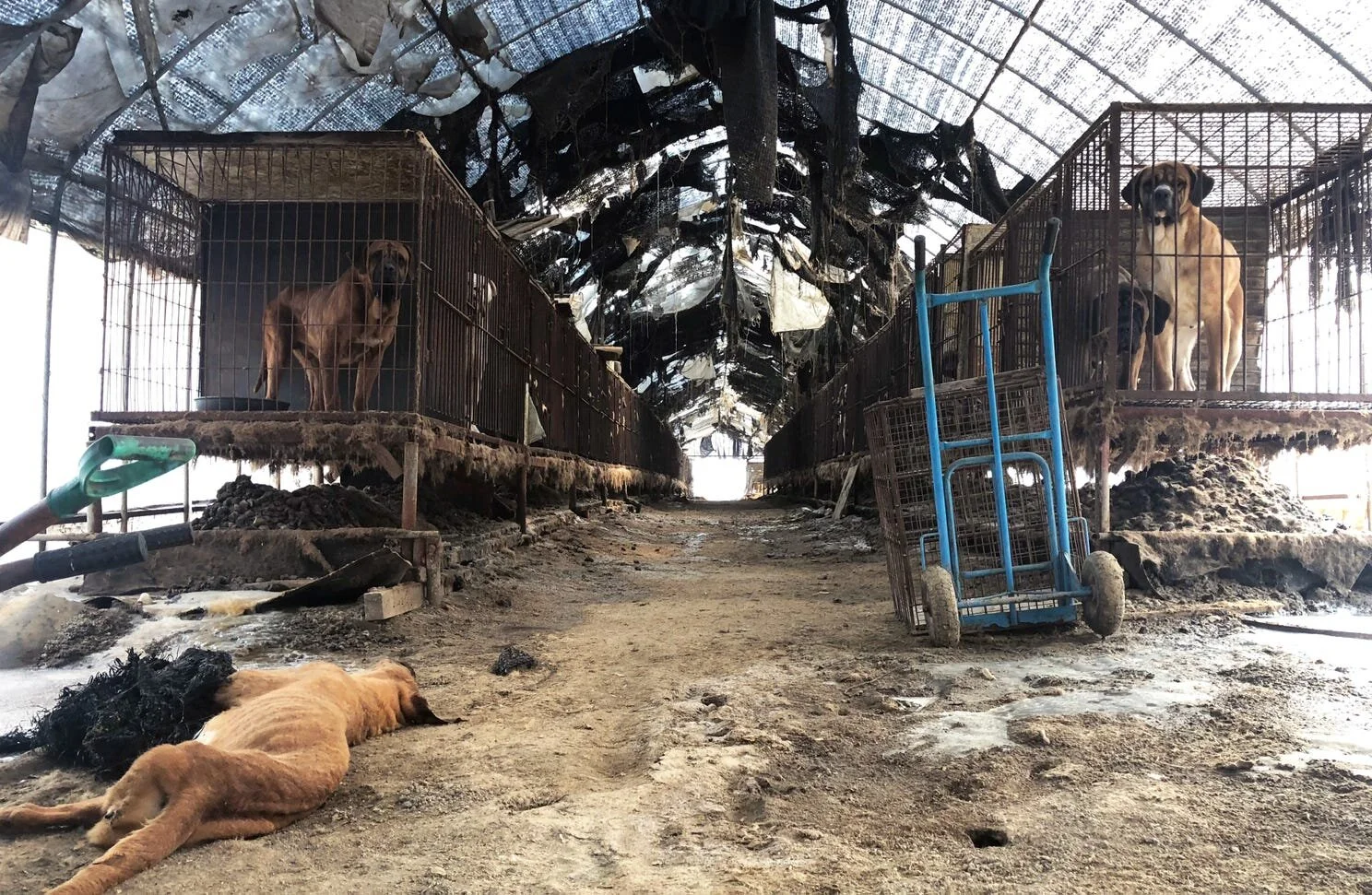
Visitors to South Korean dog farms routinely describe them as cruel and inhumane. Dogs are crammed in wire cages, never cleaned, and fed the worst kind of food, including meat from dead dogs and feces.
If the dogs manage to survive these conditions, a horrifying death is waiting. Workers string up the animals by their necks and hang them, drain their blood, shock, boil, and burn them alive in the mistaken belief that dogs who are tortured as they die “taste better.”
Dogs in South Korea are usually killed by electrocution. Humane Society International says electrocuted dogs are soaked with water and shocked with an electric rod. The process can take 2 to 3 minutes or more.
But as we mourn for the dogs killed in Korea, we must also realize a hard truth: Animal torture for the meat trade is also happening here, right now, in the United States. Western factory farms are often every bit as cruel as dog meat farms — sometimes even more so.
Of the billions of chickens and pigs raised for slaughter in the U.S., many are housed in filthy, disease-ridden crates and cages too small for them to turn around or spread their wings in. Chickens and turkeys are fattened until they can no longer stand under their own weight. And when it’s time for slaughter, they are electrocuted, have their throats slit, and are plunged into scalding water, sometimes while still conscious. Ultimately, the outrage over Korea’s horrific dog meat industry should serve as a gateway issue to force us to address and correct the abuse inherent in our own animal agriculture.

SOURCES: Humane Society International; Associated Press; koreananimals.org; Sydney Morning Herald; Rakhyun Kim, University of Auckland, New Zealand, and Utrecht University, Netherlands; Anthony Podberscek, University of Cambridge, U.K.; Claire Czajkowski, Lewis & Clark Law School, Oregon; The Korea Herald; BBC; United Press International; USA TODAY research; Independent Media Institute; Reuters; Hyonhee Shin